
Best Warmup Routine Gaming: Prepare Like an Esports Pro
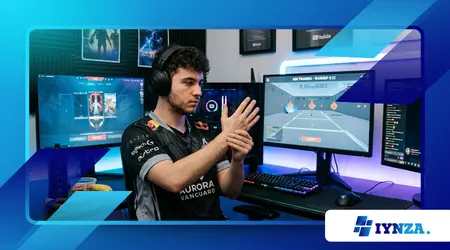
Best Warmup Routine Gaming protocols have shifted from mere suggestions to mandatory professional standards for any serious competitor entering the server in 2026.
Elite athletes don’t sprint without stretching, and modern esports stars recognize that their clicking fingers and neural pathways require the same meticulous physical preparation.
Jumping into a ranked match “cold” is a recipe for inconsistent aim, sluggish reactions, and a frustrating slide down the competitive leaderboards.
This guide dissects how the world’s top players prime their bodies and minds to achieve peak performance from the very first round of play.
Key Elements of Professional Preparation
- Physical Activation: Enhancing blood flow to the hands and wrists to prevent repetitive strain injuries.
- Neural Priming: Engaging fast-twitch muscle fibers through specialized aim trainers and reactive software.
- Mental Centering: Utilizing breathing techniques to stabilize the heart rate during high-pressure clutch moments.
- Ergonomic Calibration: Ensuring consistent posture and monitor distance for perfect muscle memory execution.
Why is a structured routine vital for competitive success?
The Best Warmup Routine Gaming functions like a high-performance engine warming up its oil before hitting maximum RPMs on a professional racetrack.
By repeating specific motions before a match, you create a psychological “trigger” that tells your brain it is time to focus and compete.
Consistency in esports is rarely about raw talent; it is about the reliability of your physical execution under extreme emotional and mental stress.
Professional teams now employ kinesiologists to ensure their players maintain high career longevity through these science-backed, daily physical and digital rituals.
How does blood flow affect your reaction time?
Cold muscles move slower, and even a micro-second delay in your index finger can mean the difference between a headshot and a loss.
Gentle wrist rotations and finger stretches increase local temperature, making your tendons more pliable and your micro-adjustments significantly smoother during intense flick shots.
++ Ranked Climb Guide 2026: How to Rank Up Faster in Any Game
What is the role of neural plasticity in gaming?
Your brain needs to calibrate its “hand-eye” link every single day to account for slight variations in your physical state and energy.
Short, intense bursts of tracking exercises help the motor cortex refine its control over your mouse or controller with surgical, pixel-perfect precision.
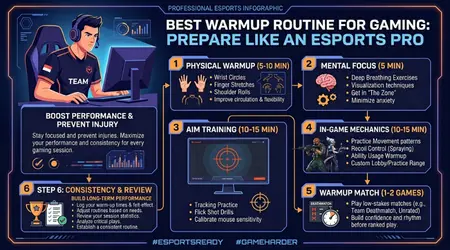
Which physical exercises provide the most significant advantage?
To develop the Best Warmup Routine Gaming, you must look beyond the screen and focus on the mechanics of your upper body.
Start with “Gliding Stretches” for your median nerve, which helps prevent the numbness often associated with long-term, high-intensity professional gaming sessions.
Pushing your palms together in a prayer position for fifteen seconds creates a gentle tension that prepares your wrists for rapid, horizontal movements.
These physical steps act as a biological insurance policy against Carpal Tunnel Syndrome, which has sidelined many talented players in the past decade.
Also read: Advanced Tactics for PvP Battles in Online Games
Why should you focus on shoulder stability?
Most aim comes from the pivot of the elbow and shoulder, not just the wrist, making upper back posture crucial for long-term accuracy.
Performing “Scapular Squeezes” helps open the chest and prevents the “gamer slouch” that restricts breathing and limits your total oxygen intake during matches.
Read more: How to Survive the First 10 Minutes in Hardcore Games
How does hydration impact your focus?
Even 2% dehydration can lead to a significant drop in cognitive processing speed, making you feel “foggy” during fast-paced tactical rotations.
Professional players in 2026 treat water intake as a performance metric, ensuring their neurons fire at maximum velocity throughout the entire tournament day.
How do pros use aim trainers effectively?
Integrating software like Kovaak’s or Aim Lab into the Best Warmup Routine Gaming allows for isolated practice of specific mechanical skills.
Instead of mindless clicking, pros focus on “Static Clicking” to build speed and “Smooth Tracking” to handle moving targets in various vertical planes.
A study by the Esports Science Institute (2025) found that 15 minutes of targeted training is more effective than two hours of casual play.
This data proves that focused, deliberate practice beats “grinding” when it comes to developing the elite muscle memory required for professional-tier competitive gaming.
What are the best scenarios for tactical shooters?
For games like Valorant or Counter-Strike, “Micro-flick” scenarios are essential because most engagements happen within a very small area of the screen.
Practicing these small, sharp movements ensures your crosshair placement remains disciplined and your reactions stay snappy enough to beat the fastest opponents online.
Is tracking more important for Battle Royales?
In games with higher Time-to-Kill (TTK), like Apex Legends, maintaining a “lock” on a moving target is the most valuable mechanical skill.
Spending time in “Reactive Tracking” scenarios mimics the unpredictable movement of human opponents, training your brain to react to direction changes instantly and accurately.
What does a 2026 professional warmup schedule look like?
The following table outlines a balanced, twenty-minute routine used by many professional organizations to prepare their athletes for high-stakes league matches.
This structure ensures that every aspect of the player’s biology and digital skill set is activated without causing early-session fatigue or mental burnout.
The 20-Minute Professional Warmup Protocol (2026)
| Phase | Duration | Activity | Goal |
| Physical | 5 Minutes | Dynamic Wrist & Shoulder Stretches | Prevent Injury & Increase Blood Flow |
| Mechanical | 5 Minutes | Static Target Clicking (Aim Trainer) | Calibrate Hand-Eye Coordination |
| Tracking | 5 Minutes | Reactive Smooth Tracking | Prime Fast-Twitch Muscle Fibers |
| In-Game | 5 Minutes | Deathmatch or Training Range | Recalibrate Movement & Game Physics |
Why is the order of these phases important?
Starting with physical stretches ensures you don’t strain a cold muscle while performing the high-speed movements required in the mechanical training phase.
Ending with in-game practice allows you to adjust to the specific “feel” and friction of your favorite title’s unique movement and recoil systems.
Can you over-warmup?
Yes, spending more than thirty minutes in trainers can lead to “diminishing returns” where your hands become tired before the actual match begins.
The goal is activation, not exhaustion; you want to feel “crisp” and ready, not fatigued and shaky from over-training your delicate hand muscles.
How can mental techniques enhance your reaction speed?
To truly master the Best Warmup Routine Gaming, you must learn to control your nervous system through conscious, rhythmic breathing and visualization.
Box breathing inhaling, holding, exhaling, and holding for four seconds each lowers cortisol levels and keeps you “in the zone” during stressful 1vX scenarios.
Imagine your brain like a computer CPU; if it’s cluttered with background stress and anxiety, it won’t have enough “RAM” to process game data.
Clearing your mental “cache” through a two-minute meditation before logging in allows for faster decision-making and better emotional control after a tough loss.
How does visualization improve performance?
Spend a moment picturing yourself hitting your shots and making the right rotations; this primes your neural pathways for those specific successful outcomes.
This technique is a staple in Olympic sports and has become a cornerstone of the psychological coaching provided to tier-one esports organizations globally.
What is the “Flow State” and how do you reach it?
The Flow State is that feeling of “effortless focus” where the game feels slow and your movements feel entirely automatic and perfect.
A consistent warmup routine acts as a bridge to this state, reducing the friction between your intent and your physical execution on the mousepad.
Elevating Your Game Beyond the Average
The Best Warmup Routine Gaming is the invisible foundation upon which every legendary professional career in the esports industry is built today.
We have seen how physical preparation, neural priming, and mental discipline work together to create a player who is consistently dangerous on the server.
Treating your body with the same respect as your hardware is the true “secret sauce” that separates the casual grinders from the elite champions.
By dedicating just twenty minutes a day to this structured protocol, you give yourself the best possible chance to climb the ranks and dominate.
Consistency is the king of esports; start your next session with intent and watch your performance reach levels you previously thought were impossible.
What is the one part of your warmup that you never skip? Share your personal routine in the comments below!
Frequently Asked Questions
Do I need a high-end PC for aim training?
No, most aim training software is designed to run efficiently on low-end hardware, focusing on low input latency rather than complex graphical fidelity.
Should I change my routine for different games?
While the physical stretches remain the same, you should adapt your aim trainer scenarios to match the specific mechanics of your primary competitive title.
Is it okay to warmup in a casual match?
Casual matches are okay, but they are often too slow and unpredictable to provide the high-density mechanical repetitions found in a dedicated aim trainer.
How often should I stretch during a long session?
You should perform a “mini-stretch” of two minutes every time you finish a match or during long queue times to keep your blood flowing.
